What is the significance of Ludvig's idol Pam
In the movie, Ludvig idolizes a lady from a famous french television show named Pam. What Ludvig sees in Pam is an ideal image he wants for himself. The embodiment of Pam is beauty and femininity; which is what Ludvig strives for. Not only is Pam someone Ludvig wants to be like, but she is also an escape and a source of comfort for Ludvig. She provides the motherly touch in the dream sequences that Ludvig's mother cannot. In the beginning we see the mother accept Ludvig, but as things get more and more difficult, she becomes cold and even downright mean to Ludvig. More and more do we see Ludvig fantasize more about Pam when things get tougher. In this sense, we can relate this portion of the movie to the film Dancer in the Dark, in which the main character becomes more and more distant from reality and engulfed in her own world of musicals and wonder. Ludvig shares this quality, albeit not to the same extent as the character of Dancer in the Dark.
What is the significance of Ludvig's relationship with
Tuesday, November 24, 2009

Monday, November 16, 2009
Far From Heaven

What is the significance of Frank and Cathy's role in terms of female and male?
In the movie 'Far From Heaven', Housewife, Cathy Whitaker finds that her husband, who is a respected business man, has been cheating on her with men. Conflicting with his own identity, we see the Frank and Cathy begin to switch roles on the movie. Cathy, at first glance appears to be a housewife whose skills are limited to homemaking and motherly duties. As the film progresses, not only do we see Cathy begin to become more than a housewife; we see her "wear the pants".
An example of this is when Frank falls in love with the blonde-haired boy from Miami and Cathy simply says "So I assume you want a divorce then" in a cold and emotionless tone, all the while Frank is sitting on the couch bawling.
Her husband, Frank, is in a state of identity crisis regarding his own sexuality. We slowly see his masculine traits begin to deter as he slowly loses his hold over his desires and sucumbs to them. We see Cathy begin to fall for a man named Raymond, but unlike her husband, Cathy is able to cope with her desire and maintain a level of control which, ultimately, empowers her masculine characteristics. She almost gives in to Raymond at the end, but through his rationalization she realizes that she and Raymond cannot be together due to society's outlook on interracial relationship; which was just as taboo as homosexual relationships.
What is the significance of Cathy and Raymond's relationship
Cathy, being seen as a liberal woman, starts talking with her former gardeners son Raymond, who has taken over his deceased father's business. Raymond is a passionate, good-intentioned man who just wants whats best for his daughter. Raymond seems to be the object of desire, which Mulvey states in her essay; although she seems to be swaying to the side of the damsel in distress being the usual object of desire. Since Cathy's role becomes more masculine, we not only can relate to her, but we again are envisioning Raymond as the object of desire. It's almost like role reversals from the original days when boy likes girl, boy saves girl, they live happily ever after, although, the ending isn't quite as happy.
Wednesday, November 4, 2009
Dancer in the Dark and the elements of the movie
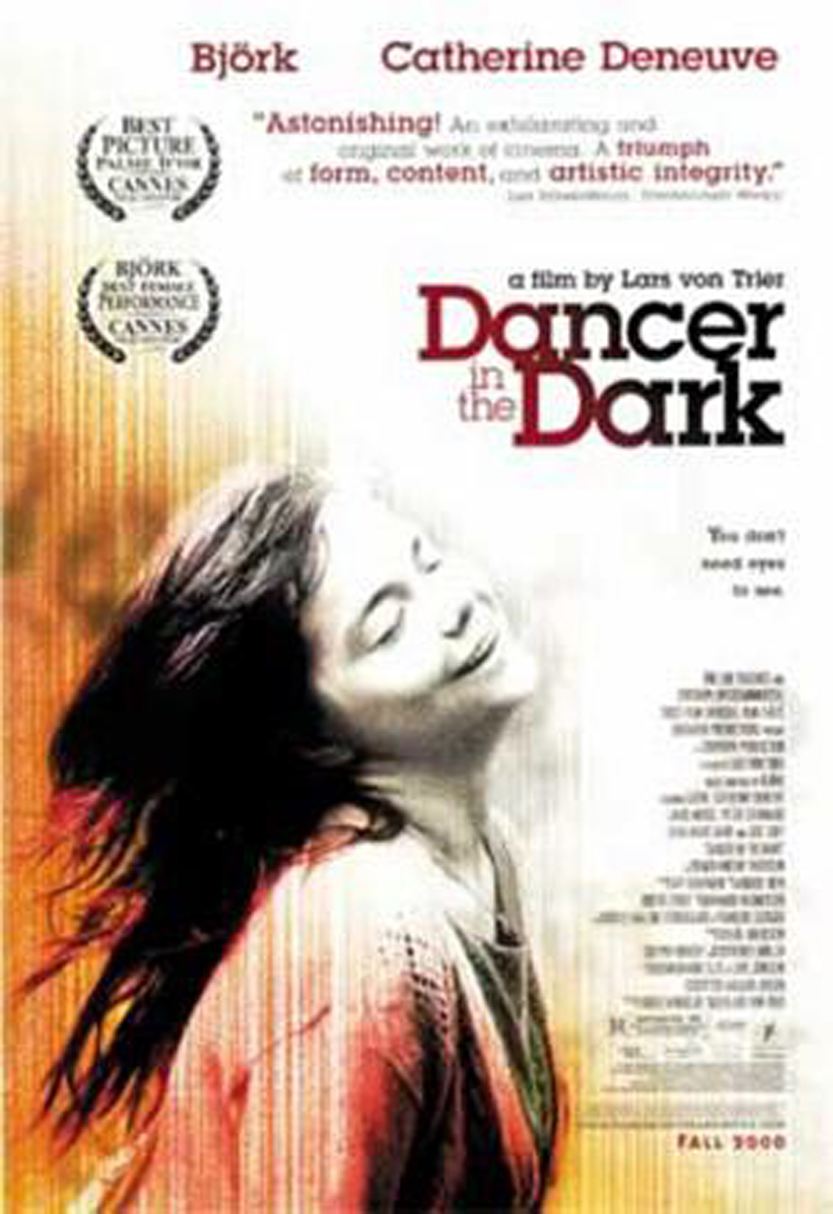
What is the significance of Selma's blindness?
The main character Selma suffers from a degenerative disease which causes her to slowly lose her sight. Through out the first half of the movie, Selma can see alright but as the movie progresses her vision gets worse. In my opinion, this serves as a symbolism for her moving away from reality. Because she can't see what is around her, she begins to fill in what goes on. Selma's passion of musicals and music in general shows through her delusions she has during her difficult times. Her blindness seems to unattach her to her reality, which is filled with all kinds of hardships. The second portion of the movie is filled with Selma's fantasies of musical numbers, which in reality don't ever occur. In essence, her lack of sight allows her to peer more into her world of fantasy.
what is the significance of Selma's relationship with her friends Kathy and Jeff?
Kathy and Jeff serve as a string that allows Selma to be connected to reality. Granted they do appear in Selma's musical numbers, they link together reality and fantasy, because the viewer sees Jeff and Kathy singing and dancing, only later to see them in their normal state. Jeff and Kathy are used to allow the viewer to see when the fantasy ends. Selma often strays from reality; she becomes more and more involved in her own created world, all the while serious things are happening around her. Although she has this escape, Jeff and Kathy serve as kind of guide for her to "wake up" and respond to the situation
Monday, October 5, 2009
Wednesday, September 30, 2009

White Vs. Epileptic
What is the significance of Jean-Christophe's hunger for power?
Epileptic is the story of a boy dealing with his older brother's sickness, which is epilepsy. Although we see Pierre ( the author and main character) and his struggles, we also see the struggles of his brother Jean-Christophe as he copes with his disease. It's tragic for Jean-Christophe mainly because he sees it as a weakness. He fantasizes about power by imagining himself to be Hitler and leader of the Nazi army. Jean-Christophe is by no means anti-semetic, he just uses it as an escape from his reality that he sees as weakness. David B. plays with the pictures by overemphasizing the leader. Jean-Christophe ( assuming it is him) is seen in all pictures as the center or twice the size. In Egyptian pictures, it is noted that people of power are pictured significantly larger than the servants to depict their power. David salutes Egyptian mythology by placing Anubis, the Egytian God of the death realm, in the comic.
What is the significance of of Daved B's depiction of Jean-Christophe's fantasy.
Hayden White says this about humanity
"Far from being a problem, then, narrative might well be considered a solution to a problem of general human concern, namely, the problem of how to translate knowing into telling"
David B uses the illustration to tell what he knows about his brother: Jean-Christophe despises weakness. We get a glimpse of the present in the beginning of the book as we see Jean-Christophe as bloated, scarred, and slightly disfigured. Through out the book Jean-Christophe leads a destructive and fantasy filled lifestyle. At one point David B., in the form of Pierre, tells Jean-Christophe that he has become more careless; this is after Jean-Christophe walks in front of a car. It seems as if Jean-Christophe trys to fight hard and deny his reality but deep down knows it's inevitable and that he will have to face it. The Jean-Christophe of current day we see is the one who accepts his destiny. Just like Hayden says, David B uses this narration to tell us Jean-Christophe's struggle to cope and accept his fate
Friday, September 18, 2009
V for Vendetta

What is the significance of V's mask in V for Vendetta?
In V for Vendetta, the protagonist is wearing a Guy Fawkes mask; the mask, for the most part is generic with no significant facial features other than a smile and mustache and beard. But why did Alan Moore choose a Guy Fawkes mask for the main character?
In order for us readers to relate to V, we must first understand the significance of the Guy Fawkes mask. Guy Fawkes was a man who attempted to destroy the Parliament building in England as a way to strike out against the Protestant church. Now fast forward into the Alternate universe of V for Vendetta. V's mask is his symbol of rebellion against the oppressive totalitarian government. The reasoning for V's mask is so he can conceal his identity.
There is more to the mask however. We readers want to relate to V because we would like to think that we ourselves have the courage and motivation to do what V does. In McCloud's book, he states that our species is a selfish one, plugging away our own likeness into things that really have no meaning. Behind V's mask is a face that we never see; we as readers would like to think that the face behind the mask could be our very own. V's mask is recognizeable mainly by his actions and reading from an outside view, us readers tend to sway with V, no matter how terroristic his acts can be.
But what is the significance of V's hidden identity?
Although we learn little about V, we learn enough to determine that he is a legitimate character in the story. However, he is mysterious to the point where we can see ourselves in V. Would we do what V does? Would we have the strength to do the things he did? Although we see an overview of both sides and see how corrupt the government is; if we were civilians in England in the comic book, who knows what kind of character we would be.
Wednesday, September 2, 2009
Maus and the cartoonish feel

Art Spiegelman's Maus is a captivating tale about a survivor's efforts during the Holocaust. The story is more than just a survivor's tale, but it also paints a picture of the strained relationship between the survivor and his son(whom is Art Spiegelman himself). One may ask however, what is the significance of Spiegelman's cartoonish style of drawing? Spiegelman's art and style appearance is a more cartoonish format whereas the characters are animals (Jewish people are mice, Germans are cats etc. . .) I meditated on Art Spiegelman's reasoning for using animals as his way to depict characters. I have a hypothesis that wasn't brought up in class that I would like to share.
Spiegelman wants to play with our emotions and distort our sensory ques.
In the movie A Clockwork Orange, Director Stanley Kubrick plays with our sensory ques. He recognizes that we as society repsond to ques in media. When there is sad music, we automatically recognize a scene in a movie to be sad and depressing. Kubrick uses this against us by playing upbeat music to scenes of depravity and horror.
My first thought when reading Maus was "What if Spiegelman was trying to do the same thing?" The Holocaust was dreadful and a downright abomination. The horrors endured during that time were unspeakable and for that period of time, hell was on earth. We recognize the whole cat and mouse schema from our childhood. It's a popular theme in cartoons. One cartoon in general is Tom and Jerry. We as children watched it for pure entertainment, while the cartoon Tom and Jerry didn't have any subtle social commentary. Now, take that cartoon and imagine the character Tom wearing a Nazi officer uniform while poking a bayonet in the back of an emaciated Jerry dressed in Jewish Holocaust work clothes. It loses it's innocence, however we still recognize the cartoon characters as Tom and Jerry so our sensory ques become confused as to what to think of the sight.
Spiegelman possibly could have wanted to skew our visual ques in a sense that while reading the comic we just imagine these things happening to mice yet when reality hits us, we realize that it's an actual occurance in our history.
In relation to Hayden White's writing Spiegelman in a sense takes the form of a historian. In White's writing, he says that historians do not have to report the facts in a fancy narrative, they can be as bland as a bowl of white rice; their job is to file the reports and thats it. However, that is not to say that they can't recapture history in a narrative manner. Spiegelman simply prefers to narrate that particular moment in history, and such a personal one too.
-Chuck Hill- (^_^)
Subscribe to:
Posts (Atom)